
There is no city in Morocco quite like Fes. Not even close. Beneath a canopy of minarets, behind hand-carved wooden doors, and along alleyways too narrow for a car; sometimes too narrow even for two people walking side by side; the city carries 1,200 years of history like a second skin. Our Fes walking tour is your key to all of it: the iconic landmarks, the artisan workshops, the hidden courtyards, and the real everyday life of one of the world's most extraordinary cities. Known as the world's largest car-free urban area, the Fes Medina is a maze of vibrant souks, historical landmarks, and authentic Moroccan charm. A UNESCO World Heritage Site, Fes el-Bali has been continuously inhabited since the 9th century; and walking its streets, you sense every layer of that history. This is not a museum exhibit. It breathes.
Your guide meets you at your riad or hotel; or at the iconic Bab Boujloud, the ornate blue-tiled gate that signals the entrance to Fes el-Bali. Step through and the city changes instantly. The streets narrow, the sounds multiply, and the 21st century quietly retreats.
The first major stop is Bou Inania Medersa, one of the finest examples of Marinid architecture in Morocco. Built between 1350 and 1355 by the Marinid sultan Abou Inan Faris, this Quranic school is a place of extraordinary stillness in an otherwise relentless city. Every surface tells a story: geometric zellij tilework at the base, carved stucco panels above, and elaborate cedarwood screens crowning the courtyard.
From there, your guide leads you through the tangle of lanes toward the Chouara Tanneries; the image most people associate with Fes, and one that never disappoints in person. The tannery neighborhood has been operating since the 11th century. The dyes used in the ancient pits are entirely natural: blue from indigo, red from poppy or paprika, yellow from saffron or pomegranate. You view the tanneries from the terraces of the surrounding leather shops, a sprig of mint offered to soften the smell; a tradition as old as the pits themselves. Your guide walks you through each step of the leather-making process, turning a visual spectacle into something genuinely understood.
No stop on our Fes walking tour carries more historical weight than Al-Qarawiyyin. Founded as a mosque by Fatima al-Fihri in 857–859 AD, it subsequently became one of the leading spiritual and educational centers of the Islamic Golden Age; and is widely recognized as the oldest continuously operating university in the world. That fact lands differently when you are standing in the alley beside it, listening to the call to prayer echo off its ancient walls.
Adjacent to the mosque is Al-Attarine Medersa, completed in 1325 and named after the perfumers' souk that once lined the street outside. It served as a religious school for high-achieving students, many of whom went on to study at neighboring Al-Qarawiyyin. The interior is a serene, beautifully detailed space; the perfect contrast to the energy of the narrow streets just outside.
Close by, the Zawiya of Moulay Idris II draws quiet pilgrims and curious visitors alike. This shrine and mausoleum holds the tomb of Idris II, who ruled Morocco from 808 to 828 and is considered the main founder of the Medina of Fes. Non-Muslims cannot enter, but your guide shares the full story of this sacred site and its enduring place in Fassi identity and culture.
Lunch follows at a traditional Medina restaurant; a moment to pause, eat well, and let the morning settle. Expect Moroccan staples: harira soup, slow-braised tagines, and freshly baked khobz bread. Your guide will point you toward the best honest local options.
The afternoon opens into the city's commercial soul. The souks of Fes el-Bali are organized by trade; the dyers' souk, the spice souk, the copper souk; each one a sensory world of its own. When we visit artisan workshops, it is because the craft is genuinely worth seeing. You observe, ask questions, and learn. There is no pressure to buy and no commission-based agenda.
Nejjarine Square rewards visitors with beauty alone. The ornate cedarwood fountain at its center is one of the most photographed corners of Fes. Beside it, the Nejjarine Museum of Wooden Arts and Crafts, housed inside a restored 18th-century funduq, offers a quieter perspective on the city's deep artisanal traditions.
The tour then moves beyond the old medina walls to Fes el-Jdid and the golden gates of the Royal Palace. The Dar al-Makhzen serves as the official royal residence in Fes, with foundations dating back to 1276 CE under the Marinid dynasty. The seven golden doorways, flanked by hand-laid zellij mosaics and carved stone archways, rank among the most photographed facades in Morocco.
Just beside the palace, the Mellah – Fes's historic Jewish quarter – tells another chapter of the city's layered story. Built by the Marinid dynasty between the 13th and 15th centuries, the neighborhood features a distinct architectural style: slightly wider streets than the old Medina, tall balconied facades, and an atmosphere that rewards slow, attentive walking.
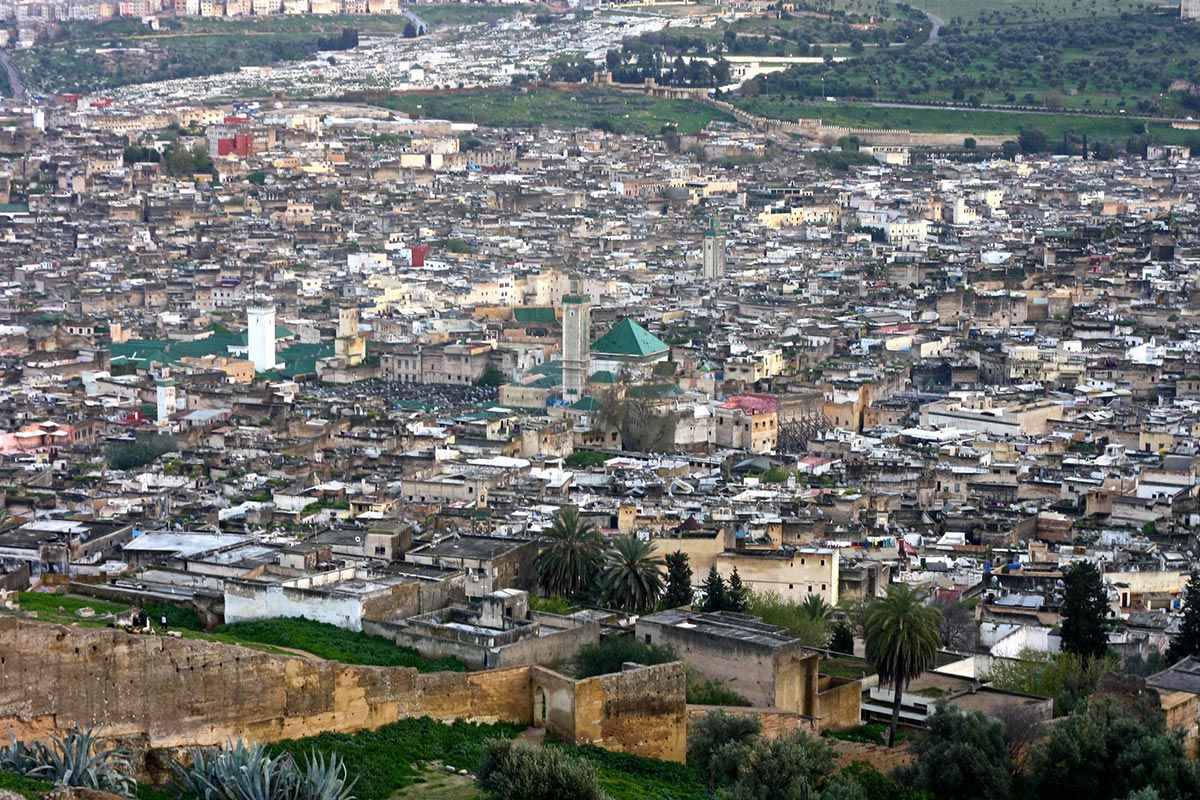
Before the tour wraps, your guide takes you up to the Merinid Tombs on the hills above the city. From here, the Medina of Fes spreads out in every direction; a sea of rooftops, minarets, and terracotta, framed by the hills of the Middle Atlas beyond. It is the view that makes sense of everything you have just walked through. The scale, the density, the sheer continuity of a medieval city this size still functioning as it always has — all of it clicks into place.
Your guide returns you to your riad or a central meeting point as the day draws to a close.